
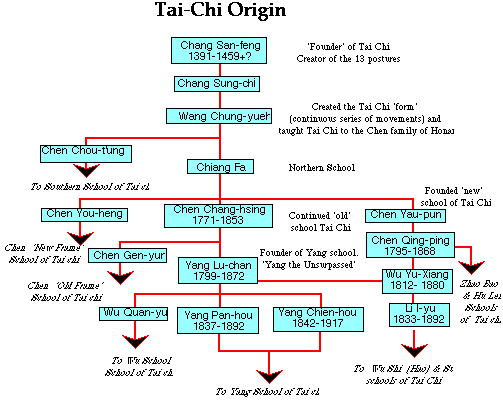
There exists a very ancient history in China of movement systems that are associated with health and philosophy. In some sense one can see all of these as contributing to the climate in which Tai Chi was born.
From the very origins of Taoism in the sixth century BC, sages like Lao Tsu wrote in the Tao Te Ching:
Yield and Overcome;And
Bend and be straight.
He who stands of tiptoe is not steady.In this and in the entire tenor of his writings Lao Tsu reflects the central philosophical underpinnings of Tai Chi Chuan.
He who strides cannot maintain the pace.
Later, in the period of the Three Kingdoms (220 to 265 AD) there was a physician Hua-tu'o who relied not only on medicine but also taught the 'movements of the five creatures' -- tiger, deer, bear, ape and birds -- a system he called Wu-chi chih hsi. He believed that the body needed to be regularly exercised to help with digestion and circulation and only by doing so could a long and healthy live be achieved. He advocated a system of imitating the movements of these animals to help exercise every joint in the body. His teaching, and its connection with the movements of animals, is probably the earliest pre-cursor of Tai Chi.
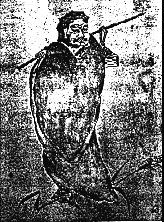
In the sixth century A.D. Bodihdharma (called Ta Mo in China) came to the Shao-Lin Monastery and seeing that the monks there were in poor physical condition from too much meditation and not enough movement, his Eighteen Form Lohan Exercise. Over time these grew to be the precursors of the Wei Chia (outer-extrinsic) school of exercise, by which is meant all the schools of kung-fu and other martial art forms which take an 'external' approach. This is in contrast to the Nei Chia (internal-intrinsic) school of which Tai Chi is a member, that take a fundamentally 'internal' approach. In the eighth century AD (the Tang dynasty) philosophers like Hsu Hsuan- p'ing developed a 'Long Kung-fu' of 37 forms. Of these certain ones such as:
- Play the Pi'pa
- Single Whip
- Step up to Seven Stars
- Jade Lady Works the Shuttles,
- High Pat on Horse; and
- White Crane (originally Phoenix) Cools Wing
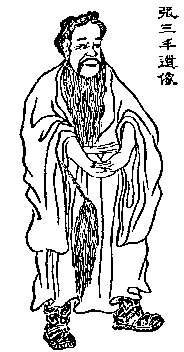
The apocryphal founder of Tai Chi was a monk of the Wu Tang Monastery, Chang San-feng to whom have been ascribed various dates and longevity's. Some scholars doubt his historical existance, viewing him as a literary construct on the lines of Lao Tzu. Other research and records from the Ming-shih (the official chronicles of the Ming dynasty) seem to indicate that he lived in the period from 1391 to 1459 (he may have been born earlier and lived later: these are simply some dates associated with him).
Linking some of the older forms with the notion of yin-yang from Taoism and stressing the 'internal' aspects of his exercises, he is credited with creating the fundamental 'Thirteen Postures' of Tai Chi corresponding to the eight basic trigrams of the I Ching and the five elements. The eight 'postures' are:
- ward-off
- rollback
- press
- push
- pull
- split
- elbow strike; and
- shoulder strike
- advance
- retreat
- look left
- gaze right; and
- central equilibrium.







0 comments
Post a Comment