1. Chen School TaiChi -- Chen Wangting, a man who discarded his high position and went back home to study Kongfu after the decay of the Ming Dynasty. He was a past general and also had a deep relation with Shao-Lin, so he has the oppotunity to collect the theories and methods of different Kongfu styles. One of the Kongfu he compiled in his hometown "Chen's Vilige" is called "13 gestures", which is a inner Kongfu.
2. Wang Zongyue-- a real recluse and great TaiChi theorist. It is believed that he carried the real esoteric skill from Chang Sanfeng. Although he was very skillful in fighting, his job was a teacher of children in small towns. It is believed that he taught his skill and the theory to Chen's Vilige. After that, only Tai-Chi and another style was passed in Chen's vilige. Wang's famous paper on Tai-Chi theory was discovered by chance in a salt shop in Wuyang County after 60 years of his death, which led the growing up of the Wushi School Tai-Chi.
3. From Chen's TaiChi to Yang School Tai-Chi. The great master, Yang LuChan went to Chen's Vilige to learn TaiChi when he was young. But at that time ( maybe even now) Taichi is a esoteric, so he pretented to be a deaf person and work there as a chore helper, while he learned the skill at the side. At last, his deed is discovered and moved the head of the family Chen Changhsing, who decided to break the rule to teach Taichi outside the family.
4. Wushi School Taichi. Wushi Xiang is a landlord, a rich. He liked Kongfu very much and he was good at making friends. When Yang Luchang come back from Chen's Vilige, he become Wushi's friends. Wushi admired the skill of Yang, but did not get the full teaching from him. (Yang is a poor person from young ). So Wushi went to Chen's Vilige to learn. But at that time, Chen Chang-hsing was dead, and no one in Chen's Vilige would taught him. So he travelled to another place, where another guy from Chen's vilige, called Chen ChingPing, taught TaiChi there.
Another reason for the growth of his skill is that his brother, a officer in Wuyang County, found the famous paper of Wang Zongyue's TaiChi theory in a salt shop by chance. That was really a great guidance.
5. Wu School Taichi-- Wu Quanyou was the head of the bodyguard squad of the imperial family of Ching Dynasty. Before he learned Taichi, he had a deep understanding of Kongfu. When Yang Luchan was old and in Beking and fell sick, he took care of Yang for he repected the skill of Yang. They became friends and Yang felt he own a debt of Wu. Yang decided to teach skill to Wu as a return, and then he let his son, Yang banhou , teach Wu. After Wu had grasped the skill, he integrate his understanding of Kongfu and TaiChi into a new style-- Wu School Taichi. His style is more soft and slow, which pay more attention to improve the general condition of people but seldom issure force.
Chang Sanfeng (1247--?) first studied at Shao-Lin, the buddhism temple and the source of nearly all the Chinese Kong-Fu, for about 10 years, then he traveled all over China, learned from Taoism and then settled in Wudang Mountain. He is a great master and recluse in Chinese history, as respected as the founder of all inner martial art, which is called Wudang Chuan. Wudang and Shao-Lin are the two major Kongfu styles in China, one is called inner Kongfu, another outer.
He initiated Tai-Chi at his late years (but it is said he lived for 130 years). After he created Tai-Chi, it is not publicly taught, but as an esoteric technique. This was passed for several generations, and there was talent people in every generation, known or unknown by the public.
 The story begins from Buddha, the old ancient time in 600 BC and the famous beginning of the Zen. When buddha lifted a lotus flower and smiled to everyone in a meeting on the Mount Lengjia, no one knew the meaning but one. JiaYe( the chinese pronunciation), the great disciple of buddha, also smiled to buddha. Then the buddha told others: "I have a treasure, like a secret mountain, which is real but with no any appearance, now I give it to JiaYe the Great." --- The treasure is passed from heart to heart directly, and this is also the case in the following generation when they pass the treasure of Zen.
Lao-Tzu (about 600BC) is the founder of Taoism, is at the same period with Buddha, in Chinese Spring and Fall Dynasty. (in fact at the same time, the Socrates in the west world). He is a master of the Chinese traditional philosophy, and systematically initiate the theory of Yin and Yang, the relation of man and nature, the relation with strong and weak. As Confucius said, he was a "magic dragon". His famous paper "Tao-Te Ching", is always treated highly for thousands of years. In that paper, he mentioned the way "learn from the nature as your teacher", "the new born baby is weak and soft, but the growing force is strong, when he grow up ,he becomes strong and stiff, the life strength is with weak and soft. When something is overwhelmed, it is near its end, although it looks strong." We can see this words strongly influence the Tai-Chi. So we say Tai-Chi is more near Taoism. After Lao-Tzu, there are a lot of Taoism training methods in China, aiming at "unity of people and nature".
There are a lot of Taoism physical practice in China after Lao-Tzu, at first they are learned from the long life animals and the nature, and then they pay attention to the breath, and and the impact of mind. They learned from outer apperence to the inner meaning of the nature phenomena. Among those people, are the Wang Chongyang in Zhongnan Mountain, Xu Xuanping in Sung Dynasty, and as the founder of Tai-Chi Chuan, Chang Sanfeng.
The Taoism methods, the Buddhism methods, and India Yoga school methods, form the unique oriental training style so different with the modern way (such as athletic way like jogging and body building). Even in today, they are helpful for the mankind to solve the problems in modern life from different ways.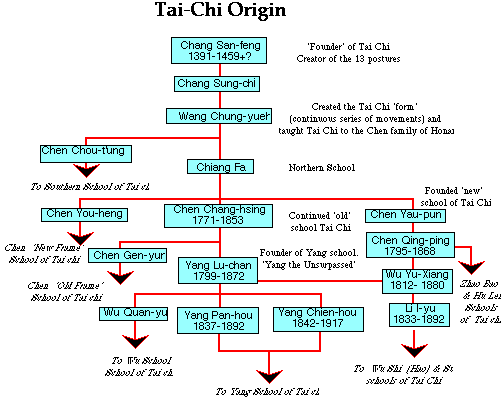
There exists a very ancient history in China of movement systems that are associated with health and philosophy. In some sense one can see all of these as contributing to the climate in which Tai Chi was born.
From the very origins of Taoism in the sixth century BC, sages like Lao Tsu wrote in the Tao Te Ching:
Yield and Overcome;And
Bend and be straight.
He who stands of tiptoe is not steady.In this and in the entire tenor of his writings Lao Tsu reflects the central philosophical underpinnings of Tai Chi Chuan.
He who strides cannot maintain the pace.
Later, in the period of the Three Kingdoms (220 to 265 AD) there was a physician Hua-tu'o who relied not only on medicine but also taught the 'movements of the five creatures' -- tiger, deer, bear, ape and birds -- a system he called Wu-chi chih hsi. He believed that the body needed to be regularly exercised to help with digestion and circulation and only by doing so could a long and healthy live be achieved. He advocated a system of imitating the movements of these animals to help exercise every joint in the body. His teaching, and its connection with the movements of animals, is probably the earliest pre-cursor of Tai Chi.
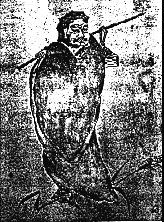
In the sixth century A.D. Bodihdharma (called Ta Mo in China) came to the Shao-Lin Monastery and seeing that the monks there were in poor physical condition from too much meditation and not enough movement, his Eighteen Form Lohan Exercise. Over time these grew to be the precursors of the Wei Chia (outer-extrinsic) school of exercise, by which is meant all the schools of kung-fu and other martial art forms which take an 'external' approach. This is in contrast to the Nei Chia (internal-intrinsic) school of which Tai Chi is a member, that take a fundamentally 'internal' approach. In the eighth century AD (the Tang dynasty) philosophers like Hsu Hsuan- p'ing developed a 'Long Kung-fu' of 37 forms. Of these certain ones such as:
- Play the Pi'pa
- Single Whip
- Step up to Seven Stars
- Jade Lady Works the Shuttles,
- High Pat on Horse; and
- White Crane (originally Phoenix) Cools Wing
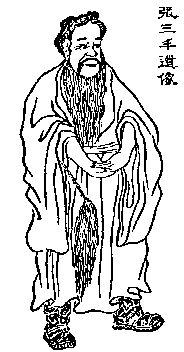
The apocryphal founder of Tai Chi was a monk of the Wu Tang Monastery, Chang San-feng to whom have been ascribed various dates and longevity's. Some scholars doubt his historical existance, viewing him as a literary construct on the lines of Lao Tzu. Other research and records from the Ming-shih (the official chronicles of the Ming dynasty) seem to indicate that he lived in the period from 1391 to 1459 (he may have been born earlier and lived later: these are simply some dates associated with him).
Linking some of the older forms with the notion of yin-yang from Taoism and stressing the 'internal' aspects of his exercises, he is credited with creating the fundamental 'Thirteen Postures' of Tai Chi corresponding to the eight basic trigrams of the I Ching and the five elements. The eight 'postures' are:
- ward-off
- rollback
- press
- push
- pull
- split
- elbow strike; and
- shoulder strike
- advance
- retreat
- look left
- gaze right; and
- central equilibrium.
Tai Chi is an ancient martial art, today associated with peace, health and relaxation. However it was created originally as a powerful form of fighting based on a deep understanding that was developed over generations.
This DVD will take you through both the Yang and Chen styles of Tai Chi. You are given not only a step-by-step guide to the forms but are then shown how to apply the movements in the close quarter combat zone. Generating immense power and speed Combat Tai Chi is a destructive and potent weapon well worth the time to learn for any Martial Artist.
Master Wong's Combat Tai Chi is a highly effective fighting art. Learn how to flick people across a room, lift them off the floor or put them to the ground with ease as you perfect the ability to use your entire body, achieving precision, balance and grace.
In over 7 hours of training footage Master Wong will guide you through the basic exercises, to the forms and then on to their application. The DVD is presented live to make training easy. Each part has been dissected into chapters so that you can select whichever part you wish to train in.
Finally, this rarely taught art is now available to learn direct from your home with personal tuition from Master Wong at the touch of a button

Tai Chi is an ancient martial art, created, and now also maintained by a precious few it has little regard in the eye of the modern martial arts enthusiast as a combat system.
What can be regarded as true Tai Chi in its real form is a profound skill based on a deep understanding of principles that where developed over generations. Now associated by most as solely an art for health, Tai Chi is often misused and largely miss taught.
With so much of the history of Tai Chi not fully accounted for how can we reach an absolute conclusion in regards to its true nature?, the simple answer is to LOOK at it.
A tool is created for a specific purpose; therefore exercising skill in a specific manner that emulates this purpose is how skill is developed. This was the essential discipline of all masters in history whether they be martial warriors, monks, or artists the philosophical background of Kung Fu and Tai Chi encompassed that practice which goes beyond perfection into the profound celestial precision of nature and the literal sense of supernatural.
Many believe it was created by a figure called Zhang San Feng during either the twelfth or fifteenth century (depending on the source). Reputedly a master of Shaolin Kung Fu he wanted to create a system more in keeping with his philosophical and religious beliefs as a Taoist monk. The revelation that gave birth to the Tai Chi fist was apparently a fight between a snake and a crane. Although there is evidence that a man called Zhang San Feng existed at this time there is little or none to support the claim that he is the creator of the system.
Many believe his appointment as creator of the system is as a result of misinformation and a popularized want to associate its creation with an individual of more ancient roots. Some believe that all the styles of Tai Chi practiced today are in fact linked to a the single man who created Chen style – Chen Wang Ting, a General during the latter years of the Ming dynasty. Chen was a native of Chen Jia Gou village, Wen County in Henan province in northern China and after the fall of the Ming Dynasty and the creation of the Ching, Wang Ting returned to his homestead and created his form.
There are many theories and explanations surrounding the Chen family, it is well known they where feared for their powerful skill and kept there art hidden. An explanation for this secrecy would be first to control the use of the skill as a dangerous, misused and/or mal-practiced art. Another reason would be to keep the art underground and out of sight from the disliked reign of the Manchu government.